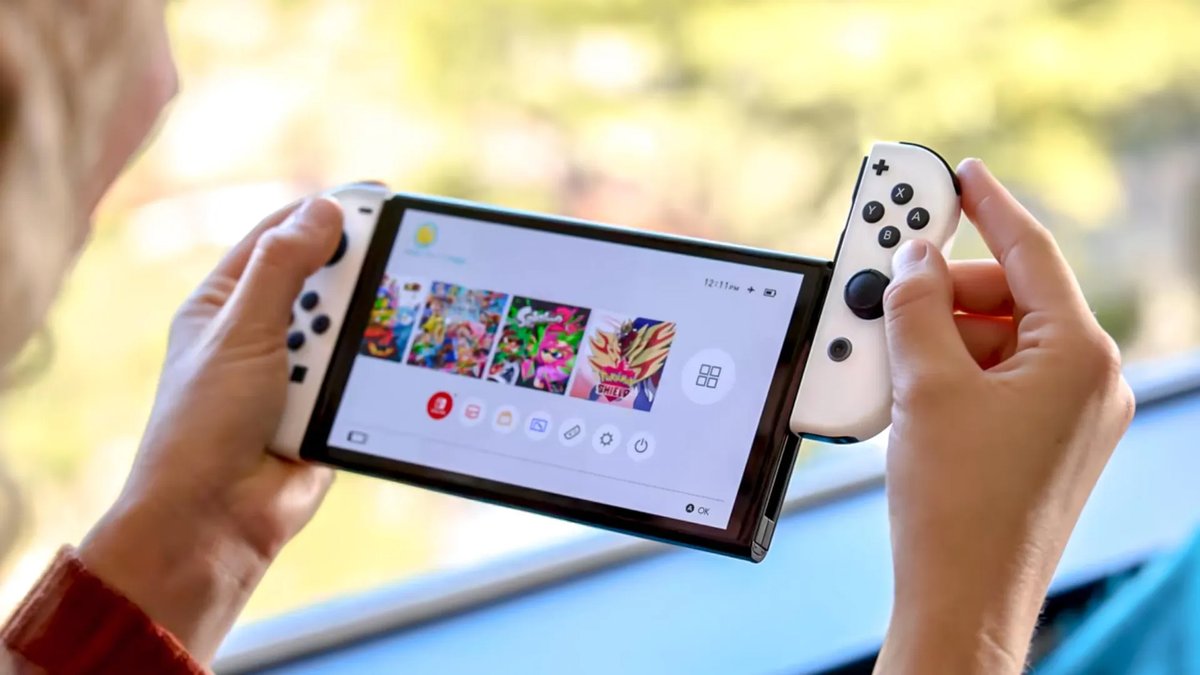
The whispers have grown into a roar: the Nintendo Switch 2 is on the horizon, promising a generational leap in portable gaming. For enthusiasts and casual players alike, the burning question revolves around the Nintendo Switch 2 Expected Features & Specifications. What exactly will this new console bring to the table, and how will it reshape our gaming experiences? From a vastly improved display to groundbreaking processing power, the details paint a picture of a device poised to deliver an unparalleled blend of versatility and performance.
Nintendo Switch 2: At a Glance
Before we dive deep, here’s a quick rundown of the key advancements you can anticipate with the Nintendo Switch 2:
- Stunning Visuals: A larger 7.9-inch LCD with 1080p resolution, HDR10 support, and VRR up to 120 Hz in handheld mode.
- Massive Performance Boost: Custom NVIDIA T239 processor featuring an 8-core ARM Cortex A78C CPU and Ampere GPU with 1536 CUDA Cores, enabling DLSS upscaling and ray tracing.
- Enhanced Storage: A significant bump to 256 GB of UFS storage for faster loading and more game installs.
- Revamped Joy-Con 2: Improved sensors, HD rumble 2, and new input capabilities.
- Backward Compatibility: Plays your existing Nintendo Switch game cards, protecting your current library.
- 4K Docked Output: Experience games in up to 4K resolution at 60 fps when connected to a TV.
- Improved Connectivity: Wi-Fi 6 for faster, more reliable wireless performance.
The Heart of the Console: Design, Display, and Raw Power
When a new console emerges, its core components tell the story of its ambition. The Nintendo Switch 2 isn't just an iteration; it's a re-imagining of what a hybrid console can be.
Console Design & Dimensions: Familiar Form, Refined Feel
True to Nintendo's design philosophy, the Switch 2 maintains the beloved hybrid form factor, allowing seamless transitions between handheld, tabletop, and TV modes. Its dimensions are roughly 4.5 inches high x 10.7 inches wide x .55 inches thick with the Joy-Con 2 controllers attached, and it weighs about 1.18 lbs (or .88 lbs for the console alone). This makes it slightly larger and heavier than the original, a justifiable trade-off for its enhanced features.
Connectivity is robust, featuring two USB-C ports: one on the bottom for charging and dock connection, and a new one on top, opening up possibilities for additional accessories or convenient charging while handheld. The familiar POWER and Volume buttons are present, alongside a 3.5mm stereo mini-plug audio jack for your favorite wired headphones.
A Visual Feast: The Next-Gen Display
Perhaps one of the most exciting upgrades is the console's display. Gone is the 720p screen, replaced by a vibrant 7.9-inch wide color gamut LCD touchscreen. This isn't just bigger; it's a significant leap in visual fidelity:
- Resolution: A crisp 1920x1080 pixels (Full HD) in handheld mode, delivering sharper images and finer details.
- HDR10 Support: High Dynamic Range capability means brighter whites, deeper blacks, and a richer spectrum of colors, making games look more lifelike and immersive.
- VRR up to 120 Hz: Variable Refresh Rate (VRR) technology, specifically G-SYNC, ensures incredibly smooth gameplay by synchronizing the screen's refresh rate with the game's frame rate. This eliminates screen tearing and reduces stutter, especially in titles with fluctuating performance.
This combination of size, resolution, HDR, and VRR means your handheld gaming experience will be significantly more fluid and visually stunning than ever before.
Powering the Experience: The Custom NVIDIA T239 Processor
Underpinning these impressive visuals is a custom-designed NVIDIA T239 processor. This isn't just a minor tweak; it's a substantial upgrade that redefines the Switch's computational prowess.
- CPU Architecture: An 8x ARM Cortex A78C CPU, with 6 cores available for developers, marks a significant jump from the original Switch's 4x ARM Cortex A57. This translates to faster game logic, better AI, and overall more complex game worlds.
- Clock Speeds: While handheld, the CPU runs at 1101MHz, boosting to 998MHz when docked, with a maximum potential of 1.7GHz.
- GPU Architecture: Based on NVIDIA's modern Ampere architecture, the GPU boasts 1536 CUDA Cores. This is a monumental leap from the original Switch's 256 Maxwell CUDA Cores. This vastly superior graphical horsepower unlocks advanced rendering techniques.
- Clock Speeds: The GPU runs at 561MHz handheld, jumping to 1007MHz when docked, with a maximum of 1.4GHz.
- Memory & Bandwidth: The Switch 2 utilizes a 128-bit LPDDR5 memory interface, delivering a substantial 102GB/s bandwidth when docked and 68GB/s handheld. Compare this to the original Switch's 64-bit LPDDR4 and 25.6GB/s, and you see a massive pipeline for data, crucial for high-fidelity graphics.
- A generous 9GB of system memory is available for games (with 3GB reserved for the system), providing ample room for larger game assets and more ambitious titles.
Key Technologies at Play: - DLSS Upscaling: NVIDIA's Deep Learning Super Sampling (DLSS) is a game-changer. It uses AI to render games at a lower internal resolution and then intelligently upscales them to higher resolutions, significantly improving performance while maintaining visual quality. This is how the Switch 2 can achieve 4K output on a TV or stunning 1080p visuals on its handheld screen without excessive battery drain or performance compromises.
- Ray Tracing: This advanced rendering technique simulates the physical behavior of light, producing incredibly realistic lighting, reflections, and shadows. The Ampere GPU's ray tracing capabilities mean compatible games will feature breathtaking graphical fidelity.
- G-SYNC: As mentioned with VRR, G-SYNC technology ensures tear-free, super-smooth visuals directly on the console's internal display.
Storage & Connectivity: Faster, More Reliable
The days of struggling with limited storage might be behind us.
- Storage: The Switch 2 comes with 256 GB of UFS storage. UFS (Universal Flash Storage) is significantly faster than the eMMC storage used in the original Switch, meaning quicker game loading times and snappier system responsiveness. A portion of this is reserved for the system, but the usable space is still a vast improvement.
- MicroSD Express: While backward compatible with existing Switch game cards, the Switch 2 introduces a slot for microSD Express cards. These next-generation cards offer much faster read/write speeds, aligning with the console's increased performance demands for expandable storage up to 2 TB. Note that non-Express microSD cards can still be used, but only for copying screenshots and videos from the console.
- Wireless: Wi-Fi 6 (Wireless LAN) and Bluetooth ensure faster, more stable wireless connections for online gaming, downloads, and accessory pairing. The dock also supports a wired LAN connection for the most reliable online experience.
Audio & Video Output: A Cinematic Experience
The Switch 2 isn't just about what you see on its screen; it's also about how it enhances your home entertainment setup.
- TV Mode: Via the HDMI connector, the Switch 2 can output stunning 3840x2160 (4K) resolution at 60 fps. It also supports 120 fps for 1920x1080 (Full HD) and 2560x1440 (2K) resolutions, offering buttery-smooth visuals on compatible displays. HDR10 support extends to TV output, ensuring vibrant colors on your big screen. It's worth noting that VRR is not available for docked output.
- Audio: Enjoy 5.1ch linear PCM audio output via HDMI in TV Mode. For handheld and tabletop play, internal stereo speakers with an independent enclosure structure deliver rich sound, with surround sound effects for headphones (and eventually for internal speakers via system update). A built-in monaural microphone features noise cancellation, echo cancellation, and automatic gain control, making voice chat clearer.
Battery Life & Charging: Endurance for Your Adventures
The internal Lithium-ion battery offers a capacity of 5220mAh, an improvement that promises approximately 2 – 6.5 hours of gameplay, depending on the game's demands. Charging the system fully from sleep mode takes about 3 hours via the USB-C port.
The New Dock: Elevating Your Home Gaming
The Nintendo Switch 2 dock is more than just a charging station; it's the gateway to your big-screen gaming experience.
- Size & Weight: Measuring approximately 4.5 inches high x 7.9 inches wide x 2 inches thick and weighing about .84 lbs, the dock maintains a compact footprint.
- Connectivity Hub: It features two USB 2.0 ports on the side for accessories, a system connector for the console, an AC adapter port, an HDMI port for TV output, and a LAN port for stable wired internet access.
The dock is essential for leveraging the Switch 2's full performance potential, including 4K output and higher GPU clock speeds. However, as noted, VRR is exclusive to the handheld screen.
Joy-Con 2: Evolution in Your Hands
The iconic Joy-Cons are getting a significant upgrade, now dubbed Joy-Con 2. These detachable controllers are integral to the Switch experience, and Nintendo has clearly refined them.
- Dimensions & Weight: Similar in size to their predecessors (4.57 inches high x .56 inches wide x 1.2 inches thick), with the [L] weighing 2.3 oz and the [R] weighing 2.4 oz.
- Buttons:
- [L] Joy-Con 2: Left Stick (pressable), Up/Down/Left/Right D-pad, L/ZL/SL/SR buttons, Minus (-) button, Capture button, Release button, Sync button.
- [R] Joy-Con 2: Right Stick (pressable), A/B/X/Y face buttons, R/ZR/SL/SR buttons, Plus (+) button, HOME button, a new 'C' button, Release button, Sync button. The "C" button is a notable addition, indicating potential new gameplay mechanics or accessibility options.
- Wireless: Both Joy-Con 2 controllers connect via Bluetooth, with the [R] also featuring NFC for amiibo support.
- Sensors: Both [L] and [R] Joy-Con 2 units feature accelerometers and gyroscopes for motion control. Critically, they also include a "mouse sensor." This could enable more precise pointing and gesture controls, similar to a Wii Remote, but integrated directly into the controller without external IR sensors.
- HD Rumble 2: The next generation of Nintendo's haptic feedback technology promises even more nuanced and immersive tactile sensations.
- Battery Life: Each Joy-Con 2 contains a 500mAh Lithium-ion battery, offering approximately 20 hours of gameplay. They can be charged by attaching them to the console or using an optional Joy-Con 2 charging grip.
Accompanying accessories include revised Joy-Con 2 Straps and a Joy-Con 2 Grip, ensuring comfort and utility.
Performance Showdown: Where the Switch 2 Stands
Understanding raw specifications is one thing; understanding how they stack up against the competition and previous generations is another. The Switch 2 is positioned uniquely in the gaming landscape.
Nintendo Switch 2 vs. Original Nintendo Switch: A Generational Leap
This isn't an upgrade; it's an overhaul. The Switch 2 boasts "10x graphical performance" over its predecessor. This is evident across the board:
- CPU: 8x ARM Cortex A78C vs. 4x ARM Cortex A57 – more cores, vastly more efficient architecture.
- GPU: Ampere architecture with 1536 CUDA Cores vs. Maxwell with 256 CUDA Cores – a colossal increase in raw graphical power.
- Memory: 128-bit LPDDR5 interface vs. 64-bit LPDDR4, and 102GB/s (docked) vs. 25.6GB/s bandwidth – a firehose of data for complex textures and effects.
- Battery: An improved internal battery.
This means visually richer games, more stable frame rates, quicker load times, and the ability to run titles previously considered impossible on a Nintendo console. The backward compatibility for game cards is a welcome feature, allowing you to bring your existing library into the new generation.
Nintendo Switch 2 vs. PlayStation 5 / Xbox Series X: Different Beasts
It's crucial to manage expectations here. The Switch 2, by virtue of its portable form factor, isn't designed to compete head-to-head with the sheer power of dedicated home consoles like the PS5 or Xbox Series X. Its compact size and thermal constraints necessitate different component choices.
However, its performance is considered equivalent to a "PS4 Pro+." This means that while it won't match the very latest graphical benchmarks of current-gen home consoles, it's capable of running graphically intensive games like Cyberpunk 2077 and Elden Ring with impressive optimizations, often leveraging DLSS to achieve solid frame rates and resolutions. It's a powerhouse in its own right, especially for a handheld device.
Nintendo Switch 2 vs. Steam Deck: A Close Race
Comparing the Switch 2 to the Steam Deck reveals a surprisingly close competition. The Switch 2's custom T239 processor is reportedly slightly faster than the Steam Deck's Zen 2 processor. While the Switch 2 might have a smaller memory footprint (9GB for games vs. Steam Deck's 16GB shared RAM), the highly optimized software and NVIDIA's DLSS technology give it a unique edge.
Specifically, the Switch 2's ability to output 4K resolution when docked, thanks to DLSS upscaling, is a significant differentiator that the Steam Deck struggles to achieve in many games. For a Nintendo Switch 2 buying guide, this comparison highlights the unique strengths each console brings, with the Switch 2 emphasizing integrated experience and power efficiency, especially when docked.
What These Specs Mean for Gamers
Beyond the technical jargon, what do these advancements truly mean for you, the player?
- Visually Stunning Games: Expect sharper graphics, more detailed environments, and more realistic character models, both on the console's screen and your TV. HDR and ray tracing will make worlds come alive with dynamic lighting and vibrant colors.
- Smoother, More Responsive Gameplay: Higher frame rates, VRR, and more powerful processing will mean fewer stutters, faster loading, and a more fluid gaming experience across all genres.
- More Ambitious Titles: Developers will have significantly more headroom to create larger, more complex games without compromising performance.
- Enhanced Immersion: HD Rumble 2 and the new "mouse sensor" in the Joy-Cons could open up new forms of interactive gameplay, offering more precise control and tactile feedback.
- Faster Access to Games: UFS storage will dramatically cut down on loading screens, getting you into the action quicker.
- Future-Proofing Your Library: Backward compatibility ensures your existing collection remains valuable, while the new hardware sets the stage for years of new titles.
Addressing Common Questions & Misconceptions
With every new console, there's always a flurry of questions. Let's clarify some common points about the Switch 2.
Is it a "Switch Pro" or a full successor?
Based on the drastic spec increases, particularly the new processor architecture, memory, and display technologies, the Switch 2 is unequivocally a full generational successor, not merely an enhanced model like the Switch OLED.
Will my old Joy-Cons work with the Switch 2?
The provided technical specifications cover the new Joy-Con 2 controllers and make no mention of backward compatibility for original Joy-Cons. While it's possible Nintendo might enable some level of compatibility, full functionality and support for new features (like HD Rumble 2 or the mouse sensor) would likely require the new Joy-Con 2.
Can it truly run 4K games?
Yes, when docked to a compatible 4K TV, the Switch 2 can output up to 4K resolution at 60 fps. This is primarily achieved through NVIDIA's DLSS upscaling technology, which cleverly renders games at a lower resolution and uses AI to intelligently reconstruct a high-resolution image. While not native 4K rendering in the same way a PS5 or Xbox Series X does, the results are remarkably close and a massive step up for a portable system.
Is it meant to replace my PlayStation or Xbox?
No. While significantly more powerful than its predecessor and capable of running demanding titles, the Switch 2 retains its core identity as a hybrid console with a strong emphasis on portability. It offers a complementary experience, excelling in handheld gaming and providing a strong living-room option, but it's not a direct competitor in terms of raw power for native 4K gaming as seen on dedicated home consoles.
The Road Ahead: What to Expect Next
The Nintendo Switch 2's expected features and specifications paint a compelling picture of a powerful, versatile, and innovative gaming device. It's clear that Nintendo, in collaboration with NVIDIA, is pushing the boundaries of what a hybrid console can achieve.
This hardware foundation sets the stage for a new wave of gaming experiences, from visually stunning first-party titles to more robust third-party support. The blend of high-fidelity graphics, advanced rendering techniques like ray tracing and DLSS, and the continuation of Nintendo's unique playstyles means the Switch 2 is poised to capture the hearts of millions. Keep an eye out for official announcements and game reveals as Nintendo prepares to usher in its next era of portable and home console gaming.